 |
The statue on the top of the entrance was created by
Jules-Félix Coutan's and is called "Transportation".
Minerva and Hercules (Wisdom and Strength) hold
up a standing figure of Mercury (Commerce).
It's surrounding a 13 foot Tiffany glass clock. (Ch. 131) |
Construction began on the Grand Central Depot in 1871. (Ch. 69) The creation of the terminal would make 4th Avenue (now Park Avenue) the hoity-toity (side note: had to google the spelling... I've said it before but never have seen it in print) neighborhood it is today. (Ch. 69) In 1871, it was known as "Death Avenue" because of all the public transit on the street. (Ch. 69) Fast forward 40 years, and the building as we know it (the "grandest Beaux-Arts structure in the city") was finished in 1913. (Ch. 131)
 |
Seriously, click the photo so you can see the rectangle.
It made my day and felt like a true scavenger hunt find. |
However, what Grand Central really is known for is the
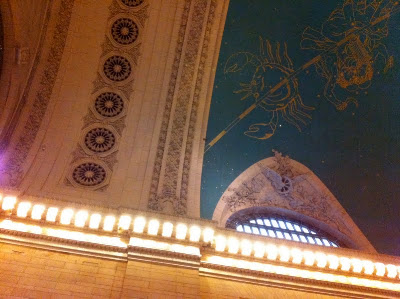
interior. Unfortunately, I don't have the best photos of the interior. Google it. :) What I do have is the photo on the left. The view of the stars that we can see in the Main Concourse almost didn't happen. If you click on the photo, I think that you will be able to see a small rectangle where the rod meets the marble. That rectangle was left as a reminder of just how dirty the concourse ceiling was and how something so spectacular almost wasn't found. (Ch. 173) For my law friends, you remember the case.
Penn Central (1978). (Ch. 173 and Property, Fall 2007)
The funny thing about the concourse ceiling is that the artist painted it backwards. The books says that it's probably a result of the artist relying on a celestial globe as his model. Therefore, it's a God's eye view of the heavens. (Ch. 131)
 |
This photo is taken from one of the pop-up restaurants in the terminal May 22, 2010.
Little did we know all the cool things to see there! |
One of the things that's been on my list for a long time to see is the Graybar Passage (a very original name because it connects the terminal to the Graybar building). In that passage, you can see artwork left over from WPA artists from the Depression. (Ch. 131) I wonder how many people pass under this every day and have no idea. Of course, I felt compelled to tell the kiosk worker why I was taking photos. I like to think that he's going to tell other people and we can all share in this not-so-secret knowledge together.
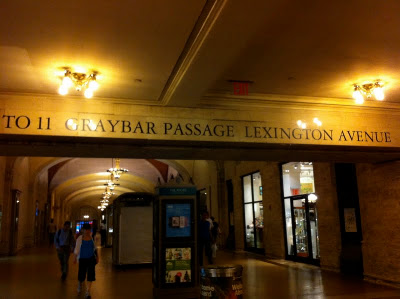 |
The passage. You can barely see where the arch is darker in color.
That's where the mural is. |
 |
| The theme of the mural is the progress of transportation. You can just make out a train. |
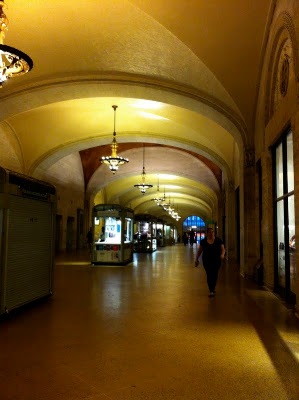 |
| A better view of how hidden in plain sight this is. |


No comments:
Post a Comment